Nahid Ul Islam
Research

Deep Learning and Computer Vision

My research experience spans Artificial Intelligence, Machine Learning, Deep Learning, Computer Vision, Image Processing, and Foundation Models. My work includes model development, experiment design, large-scale pretraining, multi-task learning, self-supervised and transfer learning, benchmarking, and analysis, using CNNs, Vision Transformers, and Swin Transformers across classification, detection, and segmentation in 2D and 3D, with distributed training on GPU and HPC clusters.

8Publications6 conference, 2 journal180+CitationsGoogle Scholar3U.S. PatentsGranted5+U.S. PatentsPending

As of October 2026

Ph.D. DissertationArizona State UniversityM.Sc. ThesisUniversity of Texas at San AntonioB.Sc. ThesisBRAC University
Arizona State University

Ph.D. Research / Dissertation

Foundation X overviewFoundation X poster
Ph.D. Research

Foundation X: Integrating Classification, Localization, and Segmentation through Lock-Release Pretraining Strategy for Chest X-ray Analysis

Training deep learning models requires large annotated datasets, but annotations are heterogeneous across tasks and datasets. Foundation X is an end-to-end framework that trains a multi-task foundation model by leveraging diverse expert-level annotations from multiple public datasets. It introduces a Cyclic & Lock-Release pretraining strategy alongside a student-teacher learning paradigm to enhance knowledge retention while mitigating overfitting. Pretrained on 11 chest X-ray datasets (~826k images) spanning 11 classification, 6 localization, and 3 segmentation tasks, Foundation X integrates all three task types in a single model. It outperforms single-task baselines with average gains of +1.0% AUC, +8.4% mAP, and +3.7% Dice, and shows strong cross-dataset and cross-task generalization. The extended version, Foundation X+ (under review), adds Region-Guided ROI Alignment to transfer detection cues to segmentation.
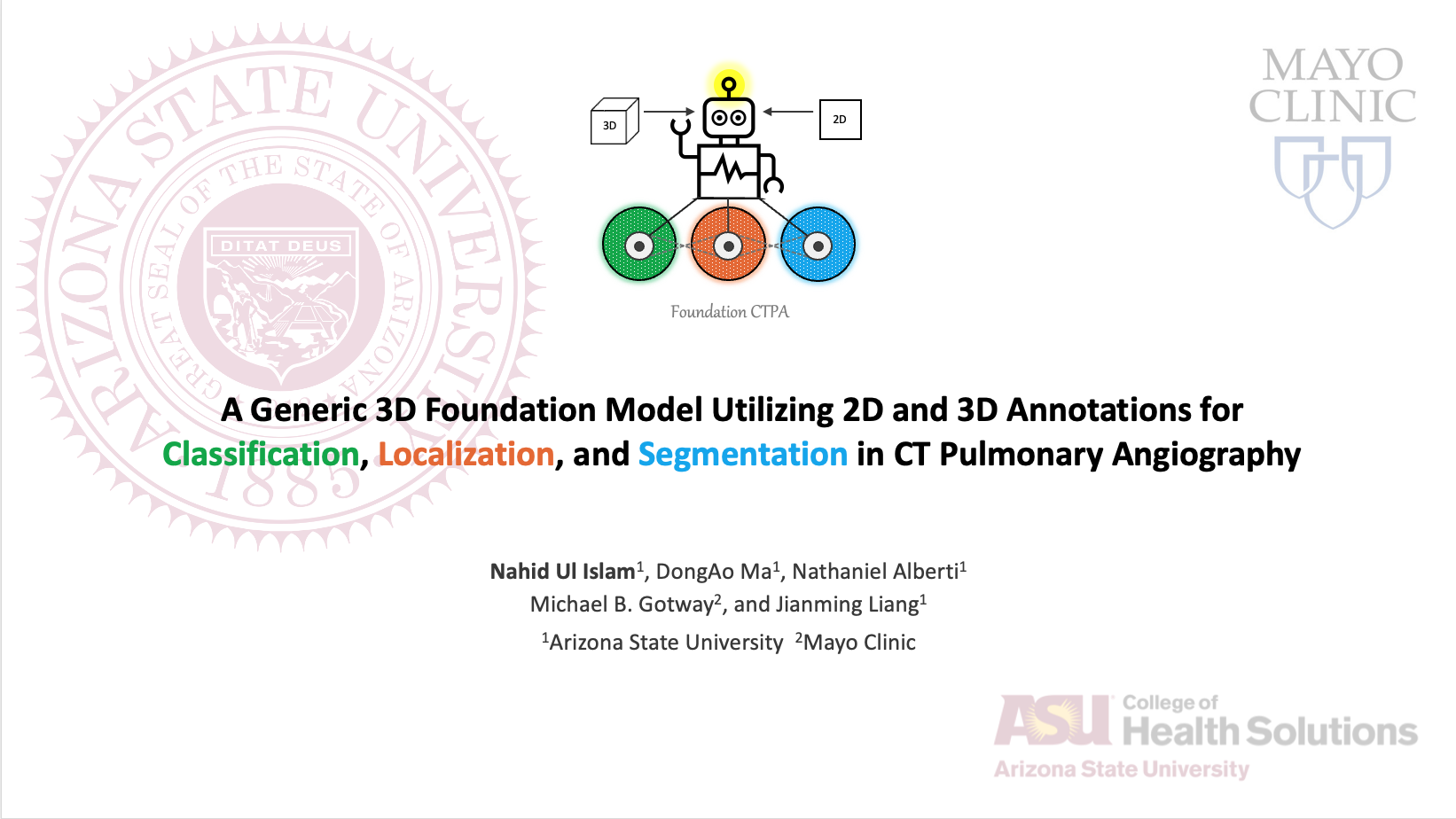
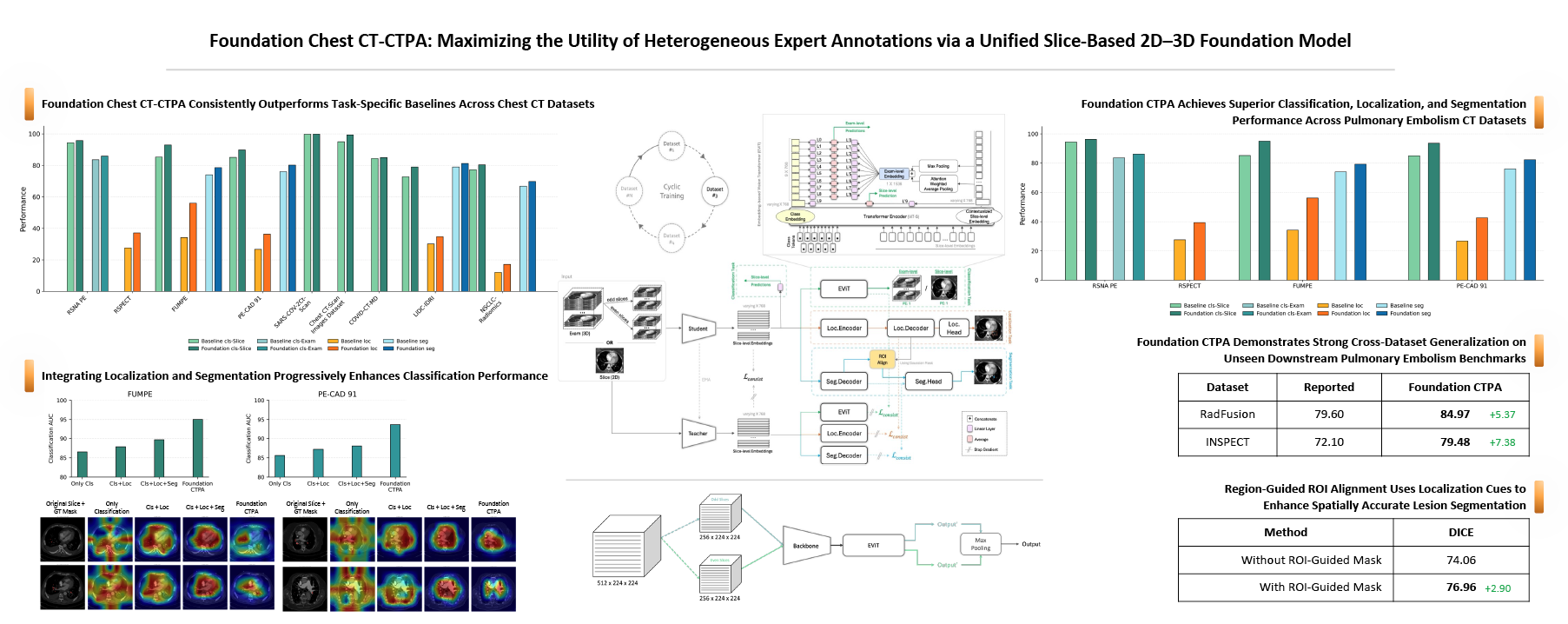
Foundation CTPA overviewFoundation CTPA poster
Ph.D. Research

Foundation CTPA: A Unified Slice-Based 3D Foundation Model for Classification, Detection, and Segmentation

Foundation CTPA is an end-to-end 3D foundation model that integrates image-level classification, volume-level classification, detection, and segmentation in one framework, learning coherent 2D slice-level and 3D volume-level representations. It is pretrained on over 1.5 million image slices from 3D volumes and introduces Region-Guided ROI Alignment to transfer detection cues to segmentation. Compared with single-task baselines, it achieves average gains of +6.7% image AUC, +2.6% volume AUC, +16.5% mAP, and +5.8% Dice, with strong generalization to unseen benchmarks and cross-domain transferability. The journal version, Foundation Chest CT-CTPA, is under review at Medical Image Analysis.

Seeking an optimal approach for pulmonary embolism diagnosisPulmonary embolism diagnosis poster
Ph.D. Research

Seeking an Optimal Approach for Computer-aided Diagnosis of Pulmonary Embolism

Pulmonary embolism (PE) represents a blood clot that travels to the blood vessels in the lung, causing vascular obstruction, and in some patients, death. CT pulmonary angiography (CTPA), is the most common type of medical imaging to evaluate patients with suspected PE. These CT scans consist of hundreds of images that require detailed review to identify clots within the pulmonary arteries. Recent research in deep learning across academia and industry produced numerous architectures, various model initializations, and distinct learning paradigms. It has resulted in many competing approaches to Computer-aided Diagnosis (CAD) implementation in medical imaging and produced great confusion in the CAD community. We have conducted extensive experiments with various deep learning architectures, model initializations, learning paradigms, and data pre-processing techniques applicable for PE diagnosis at both the slice and exam levels. The study also proposes Embedding-based ViT (EViT), a two-stage framework that aggregates image-level representations across variable-length image sequences for volume-level prediction, improving AUC by 2.22% over prior state-of-the-art.

University of Texas at San Antonio

M.Sc. Thesis

M.Sc. thesis overviewAge estimation results
M.Sc. Thesis

Face Detection, Gender Classification and Age Estimation

Improved algorithms for face detection, gender classification, and age estimation using Discrete Cosine Transform (DCT) and Histogram of Oriented Gradients (HOG) for feature extraction, with Convolutional Neural Networks and Support Vector Machines for classification.

BRAC University

B.Sc. Thesis

B.Sc. thesis overviewBengali license plate detection
B.Sc. Thesis

Automated Parking Lot Management for Bengali License Plates

Built an automated parking lot management system for Bengali license plates. License plates were localized with connected component labeling, bounding boxes, Canny edge detection, and the Hough transform, then recognized with OCR, and records were stored and managed in a database.